Web Studies 5 (WS.5)
The Generative Web: GenAI as Interface, Infrastructure, and Ecosystem
In cooperation with 

21–23 October 2026 · Alessandria, Italy
· Università degli Studi del Piemonte Orientale

21–23 October 2026 · Alessandria, Italy
· Università degli Studi del Piemonte Orientale
WS.5 calls for contributions that interrogate the fast-evolving relationship between generative AI and the Web, how this relationship is transforming the ways we access, produce, authenticate, preserve, govern, and value information.
Over the past three decades, the Web has been structured around a set of familiar operations and infrastructures: publishing and linking, indexing and ranking, searching and browsing, platformization and API ecosystems. Today, generative AI systems, in particular LLMs and multimodal models, are being woven into web interfaces and web back-ends alike: answer engines and conversational search, writing assistants embedded in browsers and editors, agentic tools that navigate the Web on our behalf, synthetic content at web scale, and retrieval-augmented architectures that treat the Web simultaneously as knowledge base, training corpus, and distribution channel.
This new configuration raises fundamental questions for Web Studies. If the Web is increasingly encountered through model-mediated interactions, what becomes of the Web’s usual ways of showing where information comes from: links, sources, documents, and traceability? If prompting becomes a dominant access mode, how do we understand the shift from querying to instructing, from navigating to delegating, from search literacy to prompt literacy? How do we assess authority, provenance, bias, and uncertainty when answers are synthesized, personalized, and conversational? What happens to the link ecosystem, web publishing incentives, and the visibility of smaller sites when traffic is mediated by generative summaries? How do regulation, platform governance, licensing, and dataset construction reshape what the Web is and what it can be?
WS.5 welcomes theoretical, empirical, methodological, technical, critical, and creative contributions that examine generative AI as:
We particularly encourage work that crosses disciplines and traditions, from computer science to information science, media and communication studies, sociology, STS, digital humanities, design, law, education, and the arts, while maintaining a shared focus: the Web as object of inquiry.
The international conference on Web Studies is a multidisciplinary peer-reviewed scientific gathering that investigates the World Wide Web as an object of inquiry. It conceives the Web as an expansive entity: an extended space that reaches every domain of life. Seen from different perspectives and disciplines, the components of the Web can be seized as data structures, algorithmic processes, visual surface, cultural uses, or artistic expressions.
Previous Editions
Web Studies was initiated in 2010. The first conference, WS.1, was organized at Tecnológico de Monterrey (Toluca, Mexico).
In 2018, the second edition, WS.2, took place in Paris (MSH Paris Nord), in cooperation with ACM SIGWEB, with the support of French institutions including CNAM, COMUE UPL, and Université Paris 8.
The third edition, WS.3, was co-organized with Université de la Manouba (Tunisia) and took place online, in cooperation with ACM SIGWEB, with the support of the UNESCO Chair ITEN and the Paragraphe Lab (Université Paris 8).
The fourth edition, WS.4, took place at Tecnológico de Monterrey (Mexico City Campus), in collaboration with the Instituto de Investigación en Matemáticas Aplicadas y en Sistemas (IIMAS), UNAM (Mexico), and in cooperation with ACM SIGWEB.
WS.5 Flyer
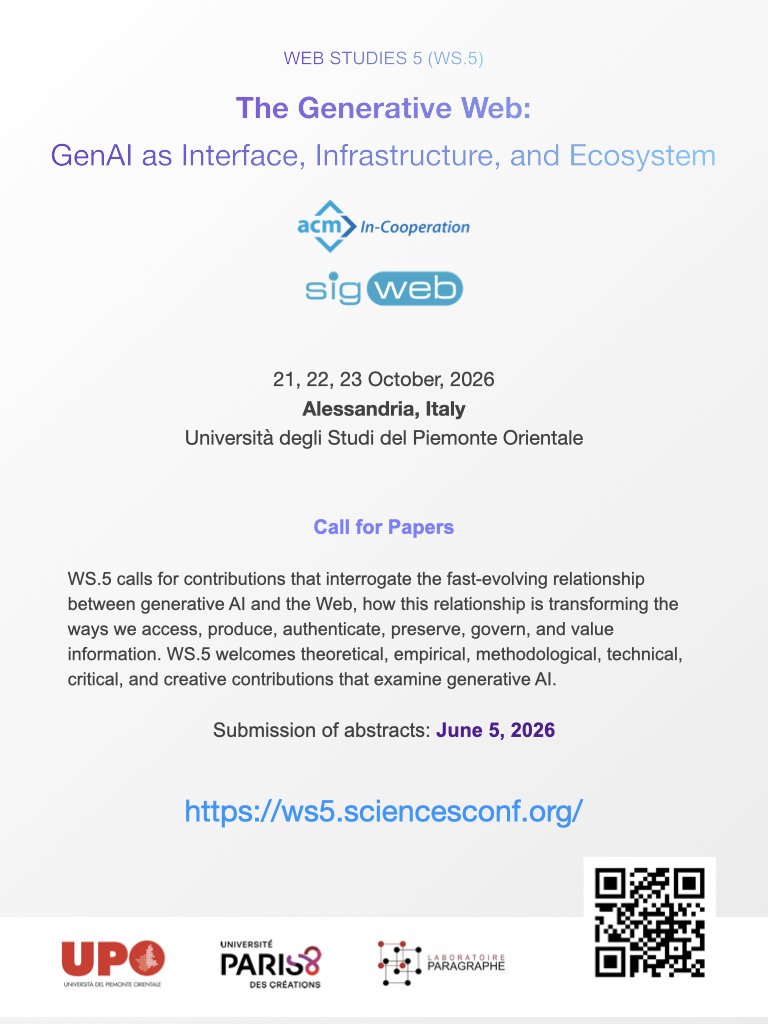
Small flyer, JPG file, 53 kb.
 Loading...